
How to Get Court Records
The Clerk of Court at San Miguel Combined Court keeps the files. Those files cover both District Court and County Court. So your first job is simple. Decide what you actually need. For a scheduled hearing, the free Colorado Judicial Branch Docket Search is the best stop. A paid vendor listed in the official Access Guide can show a real-time Register of Action. That view is not the official record. Filed papers and authenticated copies must come from the filing court itself.
Official San Miguel County court records can be requested several ways: the statewide record and document request form, the clerk counter, mail, phone, email, or fax. Mail goes to P.O. Box 919, Telluride, CO 81435. Call 970-369-3310, email SanMiguelClerk@judicial.state.co.us, or fax 970-728-6216. The counter is open Monday through Thursday, 8:30 a.m. to 5 p.m. Friday access works by phone, so anyone with a Friday appearance should call.
- Identify the filing court, case number, year, class, parties, and the exact court record needed.
- Use the free docket for a setting, the request form for an official ROA or document, or the clerk for a missing or archived file.
- Select San Miguel as the county and check a named document, Register of Action, or the certified or exemplified option.
- Supply contact details and any identity proof required for protected, juvenile, probate, or suppressed material.
- Pay the quoted copy, search, certification, mailing, redaction, or archive charge, then verify the received record with the clerk.
One caution is worth knowing. CCE is an e-filing system for attorneys and authorized parties, not an anonymous public court-record library.
San Miguel Court Record Form
The statewide form gives the clerk enough facts to pull a San Miguel County court record. That removes the guesswork. You can supply the case number, case type, filing year, date of birth, and party names. Other identifying details help too. Set the county field to San Miguel. If the case number is a mystery, party details plus the filing year can narrow things down and may save you extra research time.
The official printable record-request and copy-fee form lists common documents by type. Choices run from a complaint or information to a disposition or sentence order. The list also covers a protection order, a ticket, a divorce decree, a parenting plan, an order for judgment, a transcript of judgment, a satisfaction of judgment, probate letters, a will, and an ROA. A free-text field handles anything the list leaves out.
The official online request form shows the exact intake route Colorado uses for court files.
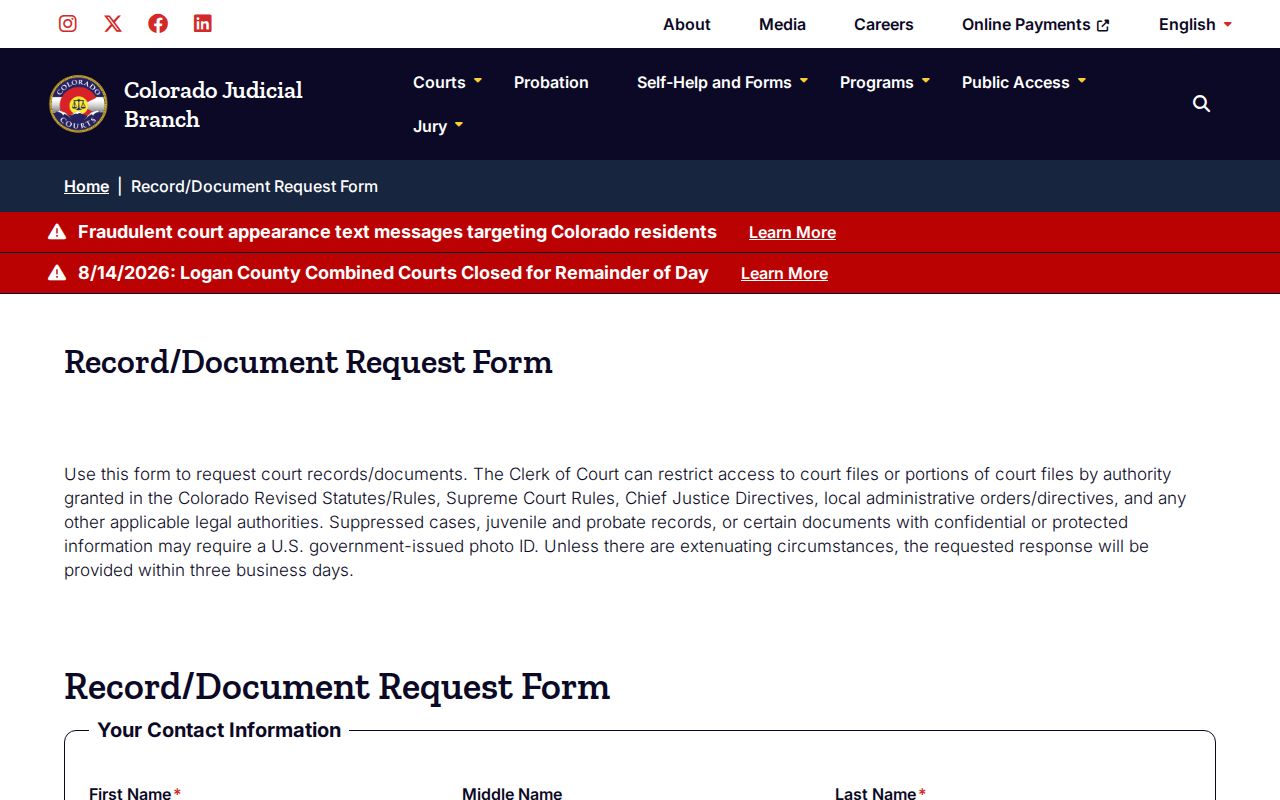
This form ties a defined San Miguel court-record request to the filing court. It also lets you state whether clerk authentication is needed.
Types of Court Records
San Miguel Combined Court holds several layers of court information. A docket is only the hearing list. The Register of Action is the chronological case index. Filed documents carry the substance behind those entries. A certified or exemplified copy adds clerk authentication. Use it for formal purposes. The layers are related, yet none substitutes for all the others.
- District Court files for felonies, general civil matters, domestic relations, juvenile cases, probate, mental health, and water matters
- County Court files for misdemeanors, traffic, small claims, protection orders, and civil claims of $25,000 or less
- ROAs that summarize filings, settings, minute orders, charges, sentences, and disposition where public
- Pleadings, motions, orders, judgments, decrees, tickets, and probate papers kept in the official case file
- Certified or exemplified copies prepared by the clerk for a use that requires authentication
Municipal-code records do not land in the Combined Court file just because the town sits inside San Miguel County. Telluride, Mountain Village, Norwood, and Ophir each keep their own municipal records. Check the citation or case caption to name the right court.
San Miguel Court Record Custodian
A common local mistake starts inside the same courthouse. The second-floor Combined Court clerk holds the San Miguel County court records. The separately elected San Miguel County Clerk & Recorder sits on the first floor. That office handles land records, elections, motor vehicles, marriage licenses, and liquor licenses. It does not hold the District or County Court case file. Look one floor up.
The County Clerk and Recorder page makes that split clear.
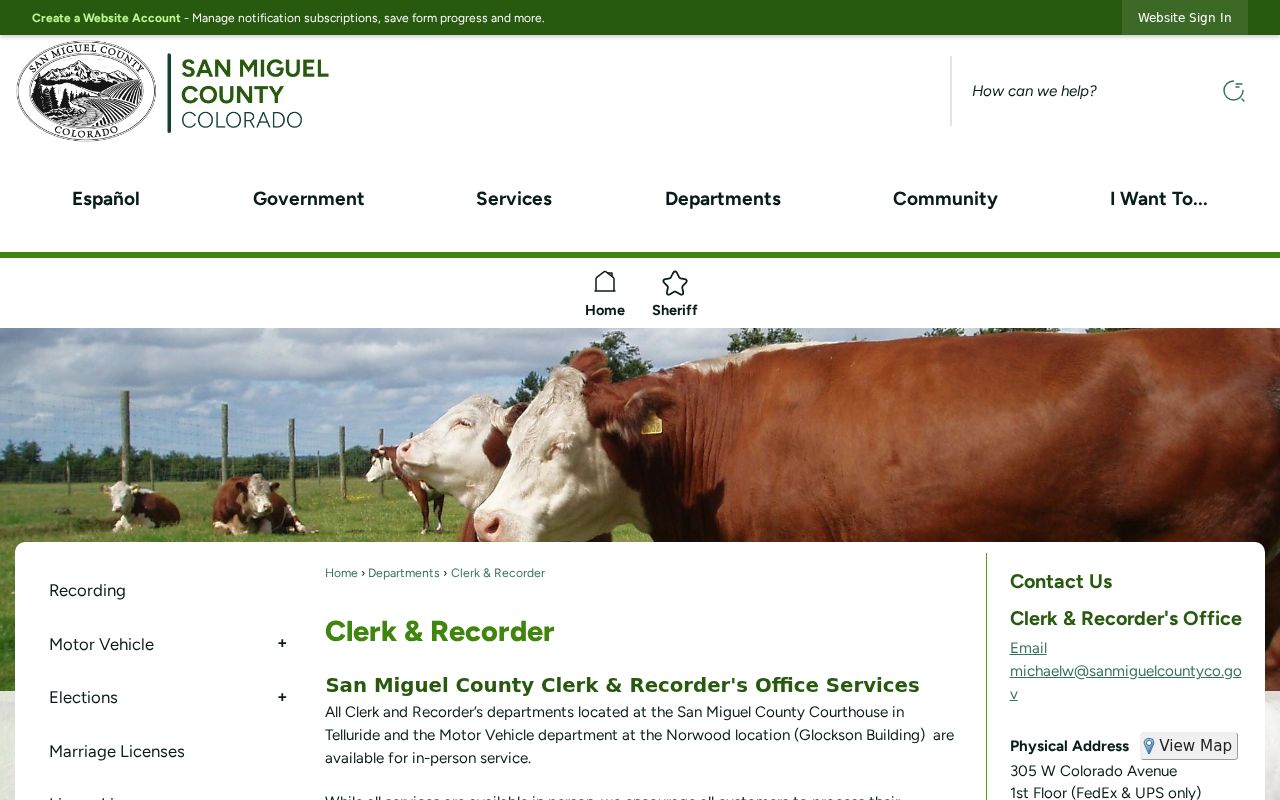
For a case chronology, an order, a judgment, or a certified court record, ask for the Clerk of Court, San Miguel Combined Court. Skip the land-recording office.
San Miguel Combined Court Clerk
305 W. Colorado Avenue, second floor
Telluride, CO 81435
970-369-3310
What a Court Record Contains
What you can see depends on the case and the access level. Public portions may show the number, filing court, division, judge, parties, and status. Filing events, settings, orders, judgments, and disposition round out the list. The free calendar shows only a sliver. It offers no full chronology. There is no judgment text and no images of pleadings.
| Case Number | A year, class, and sequence identifier such as 2026CR25. |
|---|---|
| Register of Action | The dated index of filings, settings, minute orders, and disposition. |
| Pleadings | Complaints, petitions, answers, motions, responses, and other filed papers. |
| Orders & Judgments | Signed rulings, decrees, sentence orders, judgments, and satisfaction records. |
| Calendar Fields | Date, time, duration, hearing type, location, appearance type, and courtroom when entered. |
| Exhibits & Transcripts | Special materials that may require separate instructions, access review, or a court reporter. |
Remote access leaves out or limits detailed financial data, free text, contact information, and victim or witness information. A blank calendar field does not prove the fact is missing from the official file.
San Miguel Court Record Layers
Choosing the wrong layer wastes time. A hearing docket answers when and where a case is set. An ROA maps the sequence of court activity. A filed document gives you the actual wording of a motion, order, or judgment. A certified copy proves the clerk authenticated it. The San Miguel County case search can help pin down the number before you file an official document request.
- Docket
- The free list of scheduled hearing events and calendar metadata.
- Register of Action
- A brief chronological case summary, also called an ROA.
- Filed document
- The accepted pleading, motion, order, judgment, decree, or other paper in the case file.
- Certified copy
- A clerk-authenticated copy used when a plain copy is not enough.
A vendor ROA is handy for quick research. Still, the official Access Guide warns that vendor data may be incomplete and is not the official court record. Vendor results also carry no filed document images.
San Miguel Court Record Timing
Plan on three business days for a reply to the online form, absent unusual circumstances. Help the clerk help you. Give the case number if you have it, plus the filing year, party names, and the exact paper or ROA you want. Say whether a plain, certified, or exemplified copy is required.
Real life can stretch past that target, though. Bulky packets may need mailing time. Redactions can require staff review. Old files sometimes sit off site until retrieval is paid at actual cost. When a legal deadline rides on getting the record, contact the clerk directly. A precise document name and case identifier cuts search work. The clerk alone sets the response schedule.
Certified Copies and Fees
A plain copy just reproduces the record. Certified and exemplified copies add clerk authentication. The statewide request form lets you mark which one you want. Current charges come from CJD 06-01 and the official request materials. Parties and attorneys pay no more than $15 for case copies. Nonparties have no such cap, and mailing costs climb with packet size.
| Item | Amount |
|---|---|
| Plain copy | $0.25 single-sided page; $0.50 double-sided page |
| Certified or exemplified copy | $20 per document, plus copying where applicable |
| Transcript of Judgment | $25 |
| Certificate of Satisfaction | $20 |
| Name search | $5 |
| Fax | $1 per page |
| Research or redaction | $30 per hour in 15-minute units after the first hour |
| Off-site retrieval | Actual cost |
Expect a response within three business days unless unusual circumstances slow the work. That target is no promise an archived file will arrive that fast.
San Miguel Archived Court Records
Older San Miguel County court records may live in off-site storage. Give staff the year, case class, sequence, and party names. Then they can pull the right file. Retrieval is billed at actual cost. Storage location never changes which clerk holds custody of the case.
Getting a file back and getting it released are two different things. Sealed, protected, restricted, or suppressed items still follow the same access rules. That holds true once the file returns. So paying the archive charge guarantees nothing about copying every page.
San Miguel Court Record Transcripts
A transcript comes from a court reporter or approved transcriber. The clerk cannot turn a file copy into a word-for-word hearing record. For exact pricing and ordering steps for a proceeding, ask the Combined Court directly.
Exhibits need care too. They can hold restricted content, stay under judicial control, or require a specific access order. Ask the filing court whether inspection or copying is allowed. An unseal order or other proof of authority may be needed. The same caution applies after an archived file is retrieved. Paying the actual cost does not make every item public. Describe the hearing, date, case number, and exact exhibit or transcript. That helps staff route the request.
San Miguel Federal Court Records
State and federal files live in separate systems. San Miguel County state cases sit with the Combined Court or a municipal clerk. Federal matters from the county belong to the U.S. District Court for the District of Colorado. Bankruptcy goes to the U.S. Bankruptcy Court. Remote federal dockets and documents generally run through PACER. The District of Colorado PACER page explains how federal electronic access works.
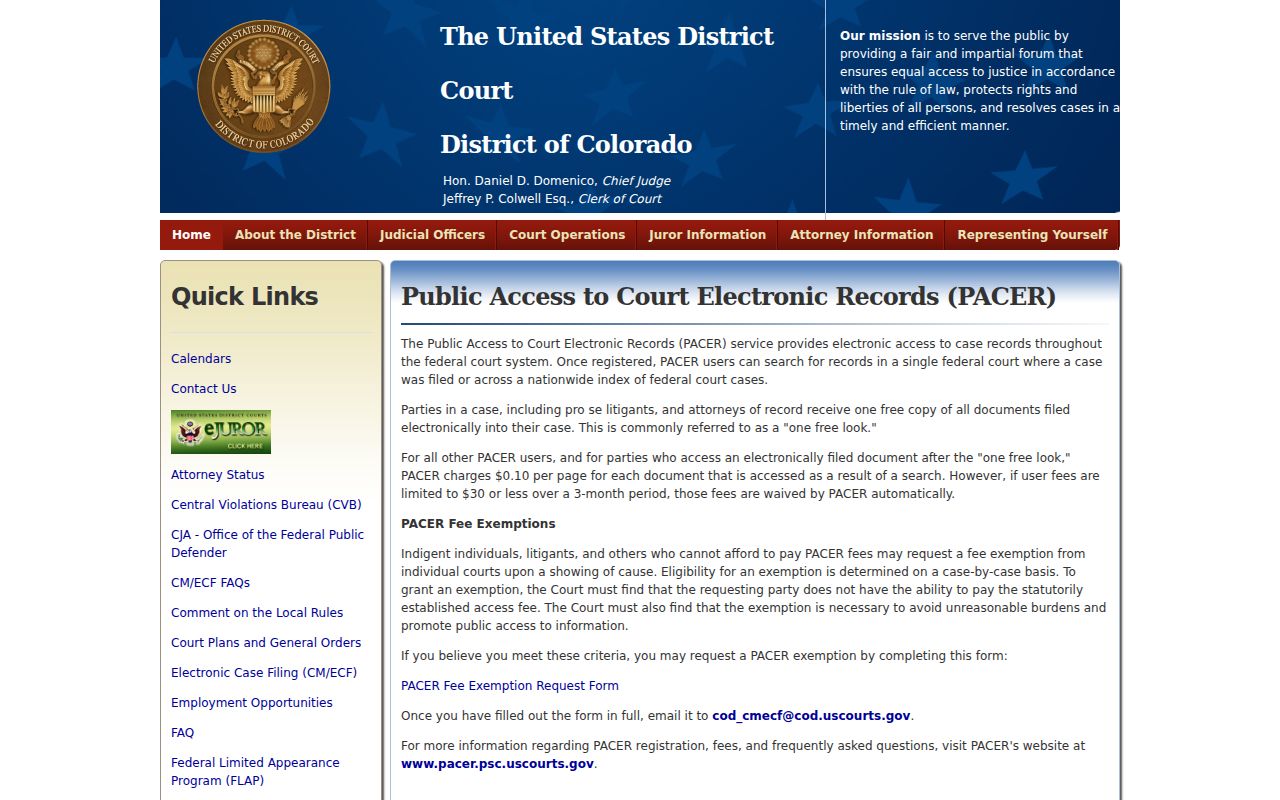
PACER shows numbered docket entries and document links, unlike Colorado's free state hearing cards. The remote fee is $0.10 per page. Each case document is capped at $3. Quarterly fees are waived when the total is $30 or less. The District of Colorado contact directory lists federal clerk locations.
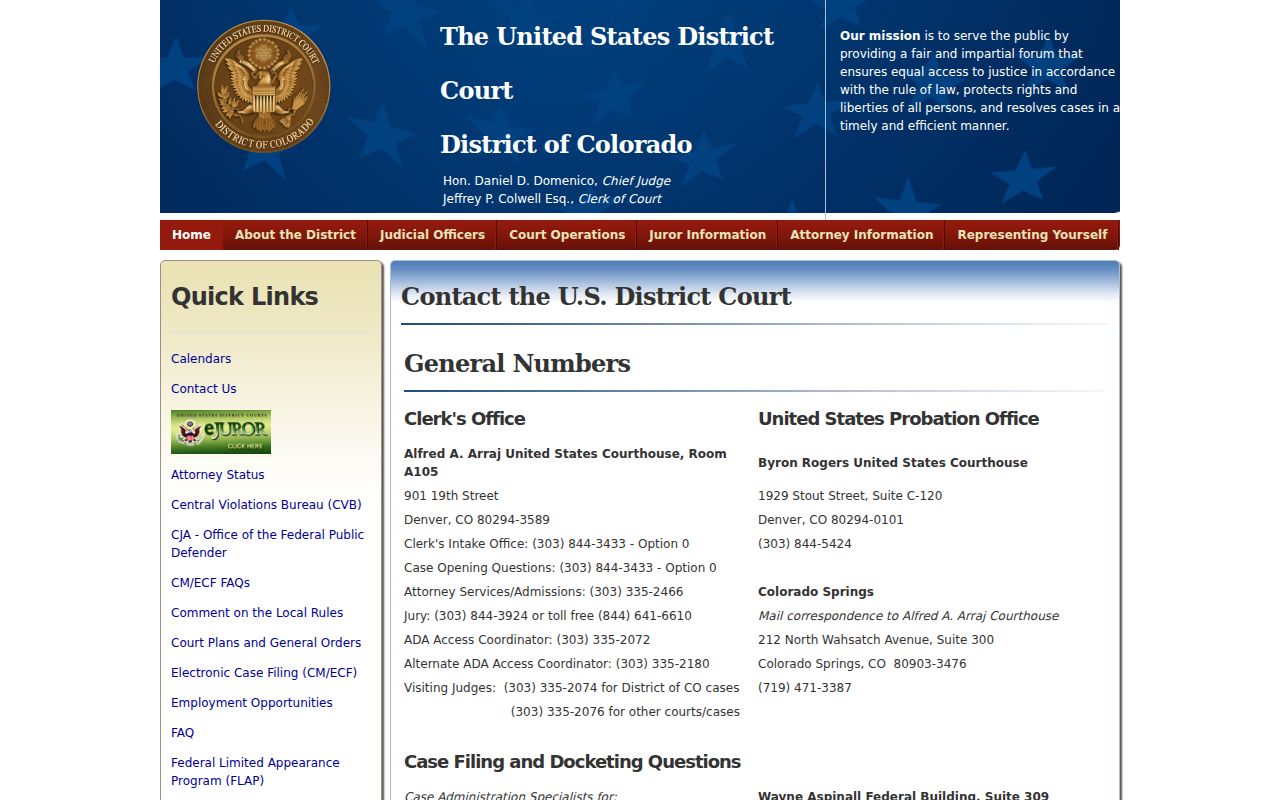
San Miguel County falls in federal Jury Division Two under the District of Colorado jury plan. Durango and Grand Junction are listed nearby. Still, the court database decides where a specific federal case was filed.
San Miguel Protected Court Records
The statewide request form warns that suppressed, juvenile, probate, and protected records may require government-issued photo identification. Access can also turn on whether you are a party, counsel, or another authorized person. An ID proves who you are. It does not create a right to sealed material.
For a third-party domestic or probate request, expect an authorization check under the 7th Judicial District access policy. Describe the item and state your role. Ask the Combined Court what proof it wants before you send sensitive documents. Remember, a public docket entry can exist. The document behind it may still be protected from remote or general access.
Public Access and Sealed Records
Colorado court files answer mainly to court-record rules and criminal justice record law, not to CORA as a universal path to case documents. Public records can be inspected. Protected ones become public only after redaction. Restricted, suppressed, juvenile, probate, and sealed material carries narrower access, and the request form may demand government photo identification for an authorized request involving sensitive material.
Key Rules:
CJD 05-01 sets Colorado court-record access, remote-field, privacy, copy, and fee rules.
C.R.S. §§ 24-72-304 and 24-72-305 govern access decisions for criminal justice records.
C.R.S. § 19-1-304 limits access to juvenile records and sensitive identifying information.
C.R.S. § 13-3-117 supports a narrow defendant-only tool for certain automatically sealed cases.
A missing public result proves nothing. A San Miguel County court record may still exist as municipal, archived, sealed, suppressed, juvenile, outside vendor coverage, or indexed under another class. An authorized requester should contact the court that filed the matter and supply proof of authority when required.